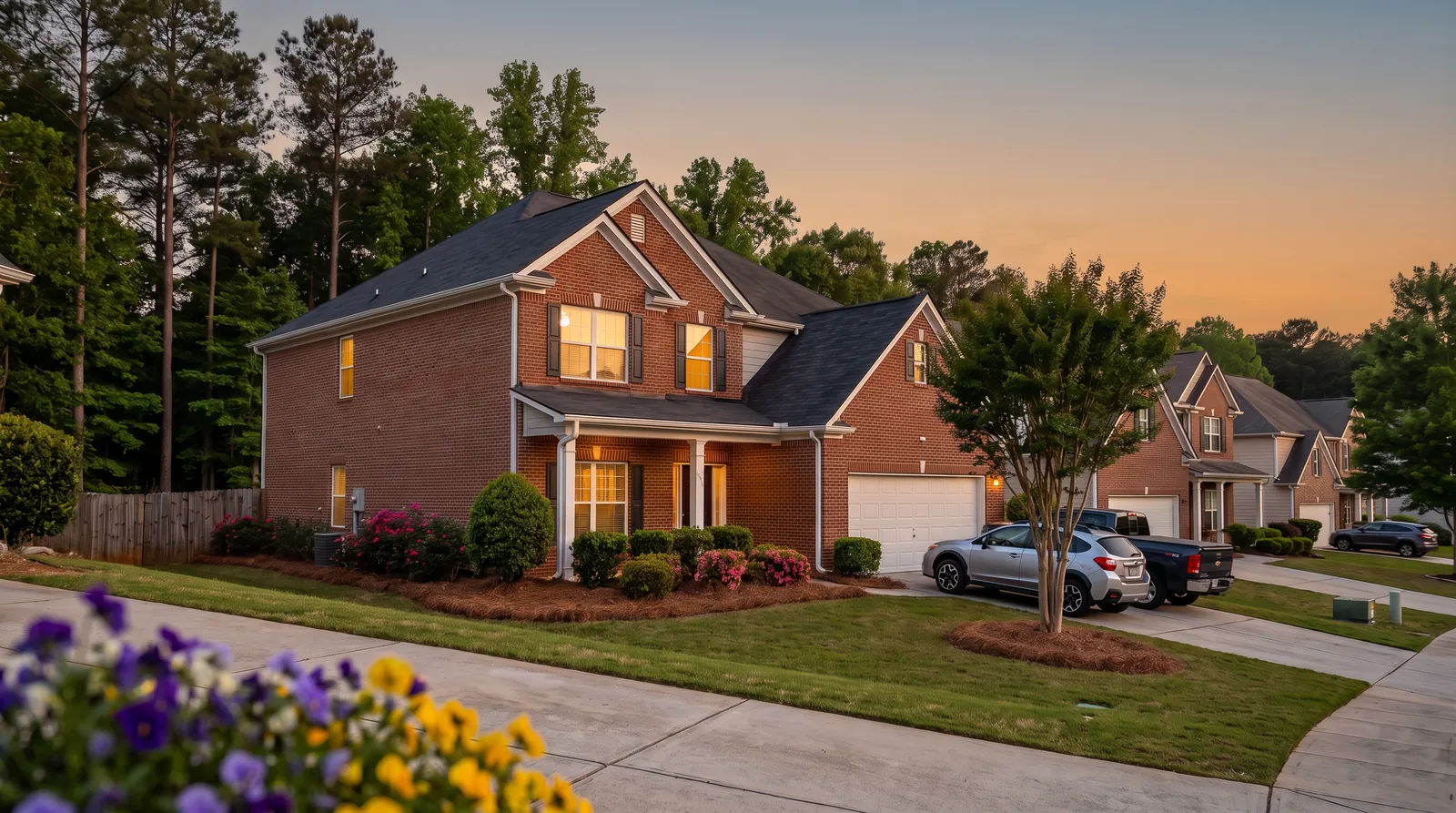
A family home at golden hour
Home / Home Insurance

Georgia Home Insurance: Insured for what it costs to rebuild.

Not what you paid, not what Zillow says. Homeowners coverage for Morrow and south metro Atlanta built on the real number, by a local insurance agency that will tell you the truth about this market.

$3,225
Avg GA Home Premium (2026 Est.)
~17 / yr
GA Tornadoes, 2001–2020
11.2 in
Helene Rain In Atlanta, 2024
15 min
To Start Your Quote
The Quick Answer

If you have a mortgage, your lender requires homeowners insurance. The number that matters most on the policy is your dwelling limit, which should equal rebuild cost, not market value. Georgia homes face severe thunderstorms, hail, tornadoes (GEMA counted 343 tornado events from 2001 to 2020), inland tropical-storm wind and rain, and occasional hard freezes that burst pipes. Many insurers use a separate wind/hail deductible, commonly 1 to 5 percent of the dwelling limit. NerdWallet estimated the average Georgia premium at $3,225 a year (February 2026). Flood and sewer backup are not covered by a standard policy; each is added separately. If the private market says no, the Georgia Underwriting Association is the insurer of last resort. All Access Agency, a local insurance agency in Morrow, quotes Georgia homeowners coverage for free at (770) 576-3416. It takes about 15 minutes to get started.

Required by
Your mortgage lender
Insure to
Rebuild cost, not market value
Not covered
Flood & sewer backup (added separately)
Free quotes
(770) 576-3416
Georgia Home Insurance, The Short Version

Most Georgia homes are insured to the wrong number. Or with the wrong deductible.

Ask a homeowner what their house is worth and they will tell you the market value. Ask what their dwelling limit should be and most give you the same number. Those are different figures. Your dwelling limit should equal what a builder charges to rebuild your house today, and after the construction inflation of the last few years, a limit set in 2020 and nudged up a few percent each renewal is quietly short of that number. You find out at the worst possible moment.

In Georgia there is a second number that matters just as much: your wind/hail deductible. Many insurers calculate it as a percentage of the dwelling limit, and after a hailstorm or a tornado the difference between a flat $1,000 deductible and 2 percent of $400,000 is $7,000 out of your pocket. The whole job is getting those numbers right, then building sensible liability, deductible, and endorsement choices around them.

The other half of the job is the weather. The Georgia Office of Commissioner of Insurance and Safety Fire says flooding, tornadoes and winter storms cause millions of dollars of property damage in Georgia each year, and Hurricane Helene in September 2024 brought 11.2 inches of rain to Atlanta. NerdWallet's February 2026 estimate put the average Georgia homeowners premium at $3,225 a year. Policies differ in the details that matter after a storm: percentage wind/hail deductibles and how the roof is paid. That is exactly why it pays to have a local agent read the fine print with you.

That is the entire offer here. As a local agency, we will tell you what your home realistically costs to rebuild and what it costs to insure. We start with our primary carrier, and through brokerage relationships we can also access 30+ other carriers when it isn't the right fit. We will explain how wind/hail deductibles and Georgia storm risk work, what flood coverage costs alongside your policy, and what the auto bundle does to the price. If you own a condo rather than a house, that is a different policy and a different set of traps. Ballpark it first with the home rate estimator, then call us for the real number.

What a homeowners policy covers. And the three things it leaves out.

A standard HO-3 policy is six coverages in a trench coat, labeled A through F. Knowing which does what is how you avoid finding out at claim time.

Coverage A
Rebuild Cost

Dwelling

The structure itself: walls, roof, foundation, built-in appliances. This is the number everything else keys off, and the one most often set wrong. It should equal what a builder charges to rebuild today, not the market price of the house.

Coverage B
10% of A

Other Structures

Detached garage, fence, shed, the workshop out back. Usually defaults to 10 percent of your dwelling limit, which is fine until you build something. A big detached garage or pole shed can blow past the default quickly.

Coverage C
50% of A

Personal Property

Everything you would take if you moved. Jewelry, art, cameras, and collections carry sub-limits, often $1,500 to $2,500, so anything meaningful should be scheduled separately for full coverage.

Coverage D
20% of A

Loss of Use

Pays your rent, hotel, and extra costs while the house is uninhabitable. After a major storm or fire loss, contractors book up and repairs can stretch for months, and a comparable south metro Atlanta rental adds up fast. This limit deserves an actual look.

Coverage E
$300k+

Personal Liability

Covers you when someone is injured on your property or you damage someone else's, including legal defense. Follows you off the property too. This is where an umbrella policy earns its keep for anyone with real assets.

Coverage F
$1k to $5k

Medical Payments

Pays a guest's minor medical bills regardless of fault, no lawsuit required. Small limits, small cost, and it quietly settles the kind of incident that would otherwise turn into a liability claim against you.

Not by default
Backup

Sewer & Drain Backup

Water that backs up through a floor drain, sewer line, or sump is not covered by a standard homeowners policy, and it is not covered by flood insurance either. It is a separate endorsement, and in a home with a finished basement it is one of the most important lines on the quote.

Not covered
Flood

Flood

Rising water from outside needs a separate NFIP or private flood policy; Georgia's insurance regulator states plainly that homeowners policies do not cover flood. A burst pipe is covered; a creek over its banks after a heavy storm is not. A large share of flood claims come from outside high-risk zones.

Not covered
Upkeep

Wear, Tear & Neglect

Insurance covers sudden and accidental, not gradual. A roof at the end of its life, slow leaks, rot, and deferred maintenance are yours. Worth knowing, because roof age and condition drive both price and eligibility, and Georgia wind and hail are the reason.

Is your dwelling limit still the right number?

It is the single most common gap we find, and the easiest to fix before you need it. We will recalculate rebuild cost with you, and it takes about 15 minutes to get started.

Coverage Basics

The four decisions that actually shape your policy.

Past the six coverages, a handful of choices determine whether your policy holds up. These are the ones worth understanding.

1. Rebuild cost, and the cushion above it

Rebuild cost is what a contractor charges today to put your house back: labor, materials, permits, debris removal, and the premium you pay for building one house rather than a subdivision. It has nothing to do with your purchase price or your mortgage balance.

Even a well-set limit can fall short after a widespread storm, when demand surge sends construction prices up all at once. That is what extended replacement cost is for: it adds a cushion above your dwelling limit, commonly 25 to 50 percent, for exactly this scenario. Pair it with building code upgrade coverage, which pays the difference when current code requires more than what your house was built to. On an older home in Forest Park, Riverdale or Jonesboro, code upgrades alone can be a serious number.

2. Replacement cost versus actual cash value

Replacement cost pays to replace what you lost with new equivalents. Actual cash value pays depreciated value. For belongings, the upgrade to replacement cost is inexpensive and worth it for nearly everyone.

Watch your roof specifically. Some policies settle roof claims at actual cash value, and some add matching or cosmetic-damage exclusions. A fifteen-year-old roof paid at actual cash value pays out like a fifteen-year-old roof while the new one is billed at today's prices, and that difference can run tens of thousands. It is one of the first lines we read on a policy you already have.

3. Your deductible, including the separate one you may not know about

The flat deductible is your main pricing lever, and the right one is the largest number you could write a check for tomorrow without wincing. Moving from $1,000 to $2,500 can lower your premium.

The one to actually read for: many Georgia policies carry a separate wind/hail deductible, either a flat amount or a percentage of the dwelling limit, commonly 1 to 5 percent. Some also carry a separate hurricane deductible. On a $400,000 home, a 2 percent deductible is $8,000, and it applies precisely when the whole neighborhood is calling roofers. Tornado season in Georgia generally runs March 1 through the end of May, and hurricane season runs June 1 to November 30. You should know your number before storm season, not after.

4. Liability, and why the umbrella is usually the best value on the page

Your homeowners liability limit protects your assets when someone is hurt on your property or you are found responsible for damage elsewhere. Most policies default to $300,000, which was a reasonable number in a different decade.

An umbrella policy stacks $1 million or more on top of both your home and auto liability, and it is often affordable relative to the protection it adds. Measured in dollars of protection per dollar of premium, nothing else on the page comes close. If you own a home in the south metro, you have assets worth defending.

Send us your declarations page. We will read it with you.

Roof settlement, wind/hail deductible, dwelling limit, sewer backup, liability. We will flag what is exposed and what is fine, and quote the fix. No pressure either way.

The Georgia Market, Honestly

Storms, tornadoes, hard freezes, and your options at renewal.

You have read the headlines. Here is the version without the panic, current as of fall 2026.

Wind, hail, and tornadoes are the Georgia story

Severe thunderstorms with damaging wind and hail are a regular part of life in the south metro, and tornadoes are not rare. The Georgia Emergency Management and Homeland Security Agency counted 343 tornado events from 2001 to 2020, about 17 a year, including a record outbreak of 41 tornadoes on January 21 and 22, 2017. The state insurance office says tornado season generally runs March 1 through the end of May.

Wind and hail are covered perils on a standard homeowners policy, but how much you pay out of pocket depends on the deductible. Many insurers use a separate wind/hail deductible, commonly 1 to 5 percent of the dwelling limit, and the Georgia Office of Commissioner of Insurance and Safety Fire warns that some policies carry a separate hurricane or wind deductible. Read yours before the spring storms, not after.

Tropical storms reach the south metro too

Hurricane season runs June 1 to November 30, and you do not need to live on the coast to feel it. Tropical systems bring inland flooding and can spawn tornadoes. When Hurricane Helene came through in September 2024, Atlanta got 11.2 inches of rain and South Georgia saw winds of 90 to 95 mph. Wind damage to the house is a homeowners claim. Rising water is not; that takes a separate flood policy, and NFIP coverage usually has a 30-day waiting period, so buy it before a storm is in the forecast.

Hard freezes and burst pipes

Georgia does not get long winters, but it does get sudden hard freezes. GEMA counted 287 winter-weather events from 2001 to 2020 and uses the January 2014 flash freeze as its worst-case benchmark. During the December 2022 freeze, the state insurance office expected thousands of claims for burst pipes and water damage. The good news: the state insurance office says standard homeowners and renters policies cover burst-pipe damage. That coverage typically depends on reasonable care, so keep the heat on and have someone check the house if you travel during a cold snap.

The gap is water that comes up instead of down. Sewer and drain backup is not covered by a standard homeowners policy, and it is not covered by flood insurance either. It is a separate endorsement, and it is one of the first things we look at for any home with a finished basement.

If you have been nonrenewed

Nonrenewal is not cancellation, and it is often not about you. Read the letter for the date coverage ends and the reason given, then start shopping right away so there is no gap, especially if you have a mortgage. If you believe the insurer handled it wrong, the Georgia Office of Commissioner of Insurance and Safety Fire takes consumer questions and complaints at (800) 656-2298.

Then move. Call us with the letter in hand. We start with our primary carrier, and through brokerage relationships we can also access 30+ other carriers when it isn't the right fit. If the private market truly says no, the Georgia Underwriting Association (Georgia's FAIR Plan, the insurer of last resort) is the fallback, at (404) 923-7431. Know the trade-off: the state insurance office notes the GUA settles wind losses at actual cash value, not replacement cost. We will tell you honestly whether it is the right answer for your home.

Got a deductible-change notice, or been told no?

Bring the letter. We will translate the deductible into dollars, price a flat-dollar option where one is available, and re-check your home. No charge and no pitch.

Seven honest ways to lower your premium. Without hollowing out the policy.

In Georgia the two biggest levers are bundling with auto and the roof over your head, because wind and hail drive so many claims. The rest stack on top.

1

Bundle home with auto

Multi-policy discounts, where available, are among the most common for a Georgia homeowner, and bundling home and auto can lower both premiums. It also puts your whole plan with one local office that can see the full picture instead of two that each see half. Start with an auto quote and we will price the pair.

2

Upgrade the roof, and ask about the discounts it may earn

Insurers price the roof harder than almost anything else on a house. Impact-resistant shingles can earn discounts with some carriers, and a newer roof changes both your rate and your eligibility. This is one of the few places where spending money can lower your rate, and after the next hailstorm you will be glad twice.

3

Raise the deductible your savings can actually cover

Moving from $1,000 to $2,500 typically trims the premium enough to pay for itself over a few claim-free years. The right deductible is the biggest number you could write a check for tomorrow without losing sleep. Ask to see the wind/hail deductible both ways too, percentage versus flat-dollar where available, so the trade-off is a decision, not a surprise.

4

Stop insuring the land

If your dwelling limit was set from market value, you are paying for coverage that can never pay out, since nobody rebuilds dirt. Recalculating to true rebuild cost sometimes lowers the premium outright. Sometimes it raises it, because the limit was short. Either way you find out now instead of at a claim.

5

Think hard before filing a small claim

A $3,000 water claim on a $2,500 deductible nets you $500 and can follow the property for years, both in your rate and in your eligibility. Call us first and we will tell you honestly whether it is worth filing.

6

Stack the boring discounts

Monitored alarm, water leak detection, updated roof, updated electrical and plumbing, new home, claims-free, paperless, paid in full, where available. Individually small, collectively real, and they are exactly the kind of thing that falls off a policy over the years without anyone noticing.

7

Ask for a renewal review, because this market moves

Premiums and policy terms keep changing, rebuild costs keep moving, and your home changes. We offer a free policy review before your renewal; just ask, or we'll reach out. We start with our primary carrier, and through brokerage relationships we can also access 30+ other carriers when it isn't the right fit. What does not work: shaving the dwelling limit to hit a target premium. That is not a saving, it is a deferred loss.

Every Georgia home is a different problem. We quote them all.

A finished basement, an older ranch, a house near a creek, a home you rent out. Each changes how the policy should be built.

Under contract, or renewing soon?

Tell us the address and we will tell you what is available, what it costs, and what would make it cheaper. Straight answer, no obligation.

Homeowners insurance in Morrow. And across south metro Atlanta.

Home insurance is priced address by address, so a house in Jonesboro and one in McDonough can price differently. Our office on Southlake Parkway, near Southlake Mall and I-75, serves Clayton and Henry counties, and Mithferson Joseph is licensed in Georgia, so we can help anywhere in the state.

Georgia home insurance questions. Straight answers.

Is homeowners insurance required in Georgia?

If you have a mortgage, yes. Your mortgage lender requires it, in writing, with the lender named on the policy.

If you let coverage lapse, the lender can buy force-placed insurance and bill you for it. That coverage is usually far more expensive and protects the lender's interest, not yours. Owning your home free and clear is the only situation where going without is realistic, and it is still a bet against your single largest asset.

What does homeowners insurance actually cover?

A standard HO-3 policy covers six things: the dwelling (structure), other structures (fence, detached garage, shed), personal property (belongings), loss of use (somewhere to live during repairs), personal liability (if someone is hurt or you damage someone else's property), and medical payments to guests.

Covered perils include fire, smoke, theft, vandalism, wind and hail (often with a separate deductible), and most sudden water damage, such as a pipe that bursts in a hard freeze. The big exclusions are flood, sewer and drain backup unless you add the endorsement, and anything that counts as maintenance.

How much is homeowners insurance in Georgia?

Estimates vary with the method behind them. NerdWallet's February 2026 estimate put the Georgia average at about $3,225 a year ($269 a month), and about $3,420 in Atlanta, for a home with $400,000 of dwelling coverage, $300,000 of liability and a $1,000 deductible. Other estimates that assume a smaller or larger home come out lower or higher.

Averages are close to useless for budgeting your specific home, which is why we quote your actual address rather than quoting a table.

How much dwelling coverage do I need?

Your dwelling limit should equal the cost to rebuild your home, not what you paid, not what Zillow says, and not what you owe. Rebuild cost is what a contractor charges today for labor, materials, permits, and debris removal.

The dangerous mistake is under-insuring. Construction costs rose sharply after 2020, and a dwelling limit set years ago and nudged along by small annual increases is often well short of today's rebuild cost. We recalculate rebuild cost with you rather than letting the number drift.

Does homeowners insurance cover hail and wind damage in Georgia?

Yes, and the details matter. Hail and wind are covered perils on a standard homeowners policy, but many insurers apply a separate wind/hail deductible, a flat amount or a percentage of the dwelling limit (commonly 1 to 5 percent), and some settle the roof at actual cash value rather than replacement cost.

Georgia's tornado season generally runs March 1 through the end of May, and hurricane season runs June 1 to November 30. Read your wind/hail deductible and roof settlement terms before storm season, and see our Georgia market guide for what to watch.

Does homeowners insurance cover flood?

No. Rising water from outside is excluded from standard homeowners policies, and Georgia's insurance regulator says so plainly. Flood is written separately through the National Flood Insurance Program or a private flood carrier. NFIP limits for a single-family home top out at $250,000 for the building and $100,000 for contents, and most policies take effect 30 days after purchase.

A burst pipe is a different thing entirely, and that sudden, accidental water damage is covered. Sewer and drain backup is a third category: not covered by homeowners or flood insurance unless you add a backup endorsement. A large share of flood claims come from outside high-risk zones, so check flood coverage rather than assume.

Are burst pipes from a hard freeze covered?

Generally, yes. The Georgia Office of Commissioner of Insurance and Safety Fire says standard homeowners and renters policies cover damage from burst pipes. That coverage typically depends on reasonable care, which mostly means keeping the heat on.

What is not covered is water backing up through a floor drain or sewer line, which needs a separate sewer and drain backup endorsement, and the wear or neglect that caused a slow leak. If you travel during a cold snap, keep the heat on and have someone check the house.

My insurer nonrenewed me. What now?

First, do not panic, and do not confuse it with cancellation. Read the notice for the date coverage ends and the reason given. If you think the insurer handled it wrong, the Georgia Office of Commissioner of Insurance and Safety Fire takes consumer questions at (800) 656-2298.

Then use the window. Call us the day the letter arrives. We start with our primary carrier, and through brokerage relationships we can also access 30+ other carriers when it isn't the right fit.

If the private market says no, the Georgia Underwriting Association, Georgia's FAIR Plan and the insurer of last resort, can be reached at (404) 923-7431.

What's the difference between replacement cost and actual cash value?

Replacement cost pays to replace what you lost with new equivalent items. Actual cash value pays the depreciated value, so a ten-year-old roof pays out like a ten-year-old roof, not a new one.

For belongings, replacement cost is worth the modest premium difference for nearly everyone. Watch the roof specifically: some policies settle roof claims at actual cash value, and the state insurance office notes the Georgia Underwriting Association settles wind losses at actual cash value. The gap at claim time can run tens of thousands. It is one of the first things we check on a policy you already have.

What is a wind or hail percentage deductible?

It is a separate deductible for wind and hail claims calculated as a percentage of your dwelling limit, commonly 1 to 5 percent, instead of a flat dollar amount. On a $400,000 home, a 2 percent deductible means $8,000 out of pocket before coverage responds.

Some policies also carry a separate hurricane deductible. When we quote, we will show you what each deductible choice does to the premium, so the trade-off is a decision, not a surprise.

Does homeowners insurance cover tornado damage?

Yes. Tornado damage is wind damage, a covered peril on a standard homeowners policy, so it falls under your wind/hail deductible if your policy has one. Damage from a tree a tornado drops on the house is typically handled the same way.

Tornadoes are not rare here: GEMA counted 343 tornado events in Georgia from 2001 to 2020. If the house is unlivable after a storm, loss of use pays for somewhere to stay, which is why that limit deserves a look too.

How can I lower my Georgia home insurance premium?

The reliable levers are bundling home with auto, raising your deductible if your savings can absorb it, and the roof: impact-resistant shingles can earn discounts with some carriers, and a newer roof helps both price and eligibility.

Then ask us for a free policy review before renewal, because pricing and policy terms move. What to avoid is under-insuring the dwelling to chase a lower premium. If the limit will not rebuild the house, the savings were never real.

Still have questions? Call (770) 576-3416. We will give you a straight answer.

Find out what your home really costs to insure.
Free, fast, and in plain English.

Tell us the address and what is in it. We will get the rebuild number right, and tell you what is available. It takes about 15 minutes to get started.