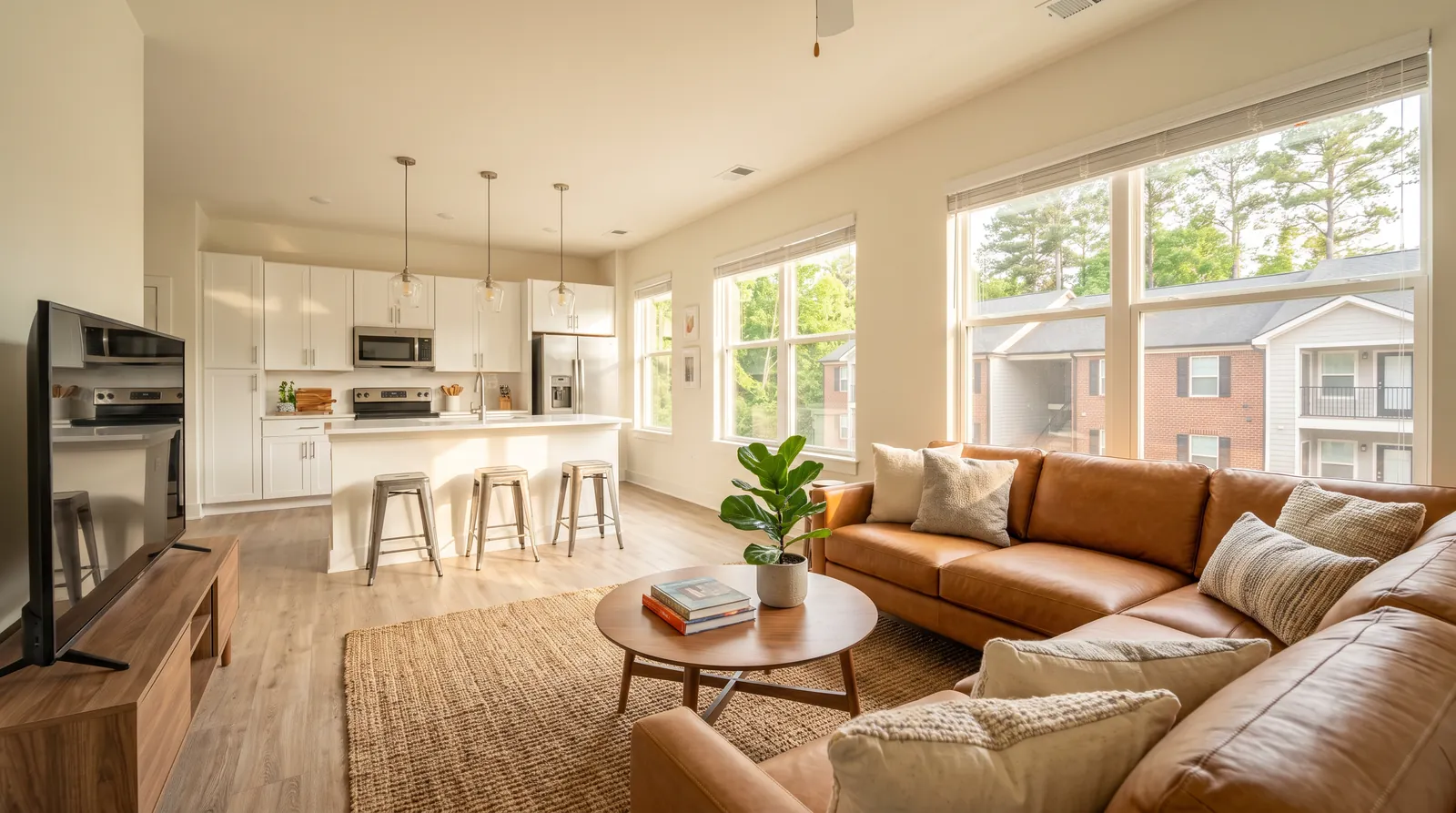
What do Clayton County renters get wrong about renters insurance?
The usual line: "If something happens to the building, the landlord's insurance takes care of it."
What's actually true: the landlord's insurance takes care of the landlord. When a fire starts two doors down or a pipe bursts upstairs, the landlord's policy fixes the walls, floors and roof. It doesn't replace your bed, pay for weeks somewhere else, or defend you if the fire started on your stove. Georgia's state insurance office has warned that landlord policies almost never cover tenants' belongings. Where so many people share walls and ceilings, that gap is one kitchen fire away.
What to do instead: carry your own policy with enough personal property coverage to replace what you own, liability that protects your paycheck, and loss-of-use coverage for a month or two away from home.
Clayton County is a renting county. Close to half its homes are rented, across apartments, townhomes, duplexes and houses in Jonesboro, Riverdale, Forest Park, Lake City, the Clayton side of College Park and the unincorporated areas around Hartsfield-Jackson. If you're signing a lease anywhere in the county, this guide answers the renters questions we hear at our office on Southlake Parkway in Morrow. Renting in Morrow itself? Our Morrow renters guide covers the Morrow specifics.
- Owner-occupied homes
- 54.5%Census, 2020–2024
- Median gross rent
- $1,433/moCensus, 2020–2024
- Georgia renters average
- ~$212/yrIII, cited by OCI, Aug 2023
- Deposit cap
- 2 months' rentO.C.G.A. 44-7-30.1
Who rents in Clayton County, and why does it change your policy?
Short answerClose to half the county's homes are rented, and the renters range from students and airport shift workers to families in rented houses. The kind of place you rent and who lives with you decide how the policy should be set up.
The U.S. Census Bureau's QuickFacts for Clayton County puts the owner-occupied housing rate at 54.5% for 2020–2024, which means roughly 45 of every 100 occupied homes are rented. The same survey puts the county's median gross rent at $1,433 a month and the average household at 2.79 people.
Jonesboro is the county seat and Forest Park its largest city. College Park reaches across the Fulton County line, so if you rent on the Clayton side, give us the exact address and ZIP code. Most of Hartsfield-Jackson sits in unincorporated Clayton County. Here's how the type of rental changes the conversation.
| What you rent | What to watch | How to set up the policy |
|---|---|---|
| An apartment community unit | Shared walls and ceilings, lease insurance rules, proof at move-in and renewal | Meet the lease's liability minimum, list the property as an interested party, size loss of use for weeks away |
| A townhome or duplex | A neighbor on the other side of the wall | Same core coverage; ask about water backup on a lower level |
| A house from an individual owner | A lease that may say nothing about insurance | Belongings for a whole household, higher liability for a yard, pets and guests |
| A room in a shared home | Roommates who aren't related to you | Each roommate carries a separate policy |
A renters policy covers the named insured and relatives who live with them, not an unrelated roommate on the same lease.
What does renters insurance cover for a Clayton County household?
Short answerYour belongings, your personal liability and loss of use, plus a small medical payments coverage for guests on most policies. The building itself and flood are not covered. Each part has its own limit, and setting those limits well is most of the job.
A renters policy, often called an HO-4 form, is built for people who don't own the walls around them. The Georgia Office of Commissioner of Insurance and Safety Fire notes that most policies cover cell phones, computers, televisions, furniture and clothing against theft, fire and other unexpected disasters.
Personal property
Furniture, clothes, electronics, kitchen gear and kids' things, against covered causes like fire, smoke, theft, wind and many kinds of sudden water damage, at home or away.
Personal liability
Pays for injuries or damage you're legally responsible for, plus your legal defense: a fire that spreads from your kitchen, a tub that floods the unit below, a guest who falls on your steps.
Loss of use
If a covered loss makes your home unlivable, it pays the extra cost of living elsewhere, such as a hotel or short-term rental and added meals, while repairs happen.
Medical payments to others
Pays a visitor's minor medical bills after an injury at your place, whoever was at fault. The limit is small, but it can settle a minor injury quickly.
Walls, roof and grounds
The structure, parking areas, pool and the landlord's appliances belong on the landlord's policy. Yours covers what you brought in.
Rising water
Flood is excluded. Contents-only flood coverage is a separate federal policy with a 30-day wait. Sewer or drain backup is usually an add-on.
Setting the limits is where most renters go wrong. For personal property, add up room by room what it would cost to buy everything again today, and choose replacement cost over actual cash value if you can. For liability, treat the lease's minimum as a floor. For loss of use, think in weeks of hotel or short-term rent at today's prices. Jewelry and watches have lower theft limits and may need to be listed separately.

What happens to your coverage when a fire or leak starts in another unit?
Short answerYour own renters policy pays for your damaged belongings and your extra living costs, minus your deductible, no matter whose unit the trouble started in. If it started in yours, your liability coverage answers the claims from the landlord and the neighbors.
In apartment buildings, townhomes and duplexes, one household's bad night travels. Smoke moves through shared attics and hallways, firefighting water soaks the units around a fire, and a supply line that bursts upstairs comes through your ceiling. Each lands on a different part of your policy:
- Smoke, soot and water damage to your things fall under personal property. Sudden water from a burst pipe or appliance line is generally covered; a slow leak over months, or flood, is not.
- Weeks away from home fall under loss of use, when a covered loss makes your unit unfit to live in.
- Damage that started with you, like an unattended pan or an overflowing tub, is a liability question. The landlord's insurer may fix the building and then come to you to pay it back.
Illustrative example, not a real claim or a quote
A family of three rents a second-floor apartment in Riverdale. A cooking fire in the unit below sends smoke through the building, and firefighting water damages their furniture, beds, clothes and electronics. Replacing it all new would cost about $14,000. The building is closed for six weeks, and the extra cost of an extended-stay room and eating out comes to about $5,000 more than they'd normally spend.
Without a renters policy, that's about $19,000 out of pocket; the landlord's policy pays none of it. With replacement cost on belongings, a $500 deductible and enough loss-of-use coverage, their own policy pays about $18,500 once the items are replaced. Had the fire started in their kitchen, their liability coverage would answer for the building and the neighbors' things.
What do Clayton County leases ask for, and what does Georgia law say?
Short answerGeorgia law doesn't require renters insurance, but many leases do, usually with a minimum liability limit, the property listed as an interested party, and proof before move-in. Georgia law does set rules for your security deposit.
We haven't found a Georgia statute requiring tenants to carry renters insurance, so the rule comes from your lease. Georgia's insurance office notes that some landlords require it. In our experience, the asks differ by landlord:
- Apartment communities with a management company usually spell it out: a minimum liability amount, the property listed as an interested party, and proof before move-in and at renewal. Our Morrow renters guide walks through that proof step by step.
- Houses and duplexes from an individual owner may have a lease that says nothing about insurance. The gap is still there: the owner's policy covers the house, not your things or your liability.
- Leases that add a charge or the property's own coverage if you don't show proof. Read what it protects. It's often written around the landlord's interests and may not replace your belongings or pay for a place to stay.
Your security deposit isn't insurance, either. Under O.C.G.A. 44-7-30.1, a landlord can't demand a deposit of more than two months' rent on leases entered into or renewed on or after July 1, 2024. After you move out, O.C.G.A. 44-7-34 gives the landlord 30 days after getting the unit back to return the deposit or give you a written list of what's being kept. Ordinary wear and tear can't be deducted, but damage from carelessness or an accident can. Renters insurance generally doesn't pay for everyday wear or pet damage; a sudden accident like a kitchen fire is where liability coverage comes in.
What should airport and logistics workers know about renters insurance?
Short answerYour belongings are covered away from home, including in your car or a work locker, but tools used for work, gear your employer owns and the car itself each have their own rules. If you own expensive work equipment, say so when you quote.
Hartsfield-Jackson sits mostly in unincorporated Clayton County, and many of the renters we talk to work at or around the airport, often on early, late or rotating shifts. The same questions come up again and again.
Things left in your car or a locker
Personal property coverage follows your belongings, so a bag or laptop you own that's stolen from your car in an employee lot, or from a work locker, is typically covered, minus your deductible. Some policies cap coverage for property away from home, so check the number. The broken window is a job for comprehensive on your auto policy; our Clayton County car insurance guide covers parked cars, airport lots and rideshare driving.
Work tools, employer gear and side work
Many renters policies set a lower limit for business property, the things you use to earn money. If you own mechanic's tools, a camera kit or other job gear, tell us when we quote so we can check the limit. A scanner, radio or tablet your employer issued belongs to your employer, so ask how they insure it. And if you run a side business from home with customers coming over, personal liability may not cover it; our business insurance page explains the options.
Does renters insurance cover storms, frozen pipes and flooding in Clayton County?
Short answerWind, hail, lightning and burst pipes are generally covered causes. Flood is not: it takes a separate contents-only flood policy, up to $100,000 for belongings above the lowest elevated floor, with a 30-day wait and very limited coverage in basement apartments.
Georgia averaged about 17 tornadoes a year from 2001 to 2020, according to the Georgia Emergency Management and Homeland Security Agency's 2022 hazard assessment, which also lists severe winter weather. Wind and hail damage to belongings is generally covered, and Georgia's state insurance office has said standard renters policies cover burst-pipe damage.
Flood is the gap. The Flint River begins in streams piped beneath the airport, and a 2006 FEMA flood-elevation notice for Clayton County named Beaver Dam, Hurricane, Jester, Mud, Panther, Sullivan and Upton Creeks and Lake Spivey. If you rent near one of them, look up the building on FEMA's Flood Map Service Center.
| What happens | Standard renters policy | What to ask about |
|---|---|---|
| Fire, smoke or lightning | Generally covered | Loss-of-use limit for weeks away |
| Wind or hail damage to your things | Generally covered | Your deductible |
| A pipe bursts in a freeze | Generally covered | Sudden discharge vs. slow leaks |
| Water backs up through a drain or sewer | Often an add-on | Water backup coverage |
| Creek or surface water rises into the unit | Not covered | A separate flood policy for contents |
Renters can buy contents coverage through the National Flood Insurance Program. FEMA's renters brochure says it covers up to $100,000 of tenant-owned property above the lowest elevated floor, takes effect 30 days after purchase, and in a basement or basement apartment covers only a washer, dryer, freezer and the food in it. Renting a lower-level unit? Ask us before you count on flood coverage there.
How much does renters insurance cost in Clayton County?
Short answerThe latest statewide figure from Georgia's insurance office is about $212 a year, roughly $17 a month (Insurance Information Institute, August 2023), up from $209 in the office's 2022 release. No official source publishes a Clayton County average.
For scale, that statewide average is about 15% of one month's median gross rent in the county ($1,433, U.S. Census Bureau, 2020–2024). Georgia's insurance office says price depends on the rental property, its location, your credit history, the company, what you insure and optional coverage. The choices that move yours:
- Your personal property limit, and whether it's replacement cost or actual cash value.
- Your liability limit. The lease sets the floor; we'd size it to what you want protected.
- Your deductible. A higher deductible lowers the premium. Pick one you could pay from savings tomorrow.
- Add-ons like water backup and listed jewelry or equipment.
- Discounts you may qualify for, such as a multi-policy discount with auto, automatic payments or paying in full, depending on the policy and your eligibility.
Should Clayton County renters bundle renters and car insurance?
Short answerIt's usually worth pricing. Putting renters and auto with one agency may qualify you for a multi-policy discount, depending on the policies and your eligibility, and one review lines up the liability on both.
Most renters here also drive, and Clayton County workers average a 31.6-minute commute each way, according to the U.S. Census Bureau (2020–2024). The two policies also meet in the parking lot: after a break-in, your renters policy can pay for the belongings taken, and comprehensive on your auto policy pays for the window. We'll show you the numbers both ways rather than promise a percentage.
What we won't do is shave your auto liability or uninsured motorist coverage to make a bundle look cheaper. Our Clayton County car insurance guide explains why those limits matter on county roads.
To quote both at once, have ready your rental address and unit number, your move-in date, a rough value of your belongings (plus any work gear worth listing), the lease's insurance section, and your drivers and cars.
The Bottom Line
In Clayton County, renting usually means sharing walls, ceilings and parking lots with households you don't control. Renters insurance keeps someone else's fire, leak or break-in from becoming your financial problem, and protects you if the trouble starts with you. Your landlord's policy covers the building and nothing of yours.
If you do one thing after reading this, check three numbers before you sign: a personal property limit at replacement cost, a liability limit that meets your lease, and a loss-of-use limit that would cover six weeks away. Then add flood if you're near a creek or on a lower level, and price it with your car insurance. More is on our renters insurance page.
When you're ready, start a quote below or call our Morrow office at (770) 576-3416, in English or Spanish.
Related Questions Clayton County Renters Ask
Is renters insurance required in Clayton County?
Not by Georgia law, and the county has no separate rule. We haven't found a Georgia statute that requires tenants to carry renters insurance. It's a lease term: Georgia's Office of Commissioner of Insurance and Safety Fire notes that some landlords require it, and many apartment communities in the county write it into the lease with a minimum liability limit and proof due before move-in.
Will my renters insurance pay if a fire or leak starts in another unit?
Generally, yes, for a covered loss. Your own renters policy pays for your damaged belongings, and for extra living costs under loss of use if the unit becomes unlivable, minus your deductible, no matter which unit it started in. The landlord's policy repairs the building. If it started in your unit, your liability coverage responds to claims from the landlord or neighbors.
Does renters insurance cover things stolen from my car in an airport employee lot?
Usually, yes. Your belongings are covered away from home, so a bag or laptop you own that's stolen from your car is typically covered under your personal property limit, minus your deductible. Some policies set lower limits for business property, and gear your employer issued belongs to your employer. Damage to the car itself, like a broken window, falls under comprehensive on your auto policy.
Does renters insurance cover a basement apartment in a flood?
No. Standard renters policies exclude flood, and the federal flood program limits contents coverage below ground. FEMA's renters brochure says contents coverage in a basement or basement apartment is limited to a washer, dryer, freezer and the food in the freezer. Above the lowest elevated floor, a renters flood policy can cover up to $100,000 of belongings. Most flood policies take effect 30 days after purchase.
How much is renters insurance in Clayton County?
No official source publishes a Clayton County average. The most recent statewide figure is about $212 a year, roughly $17 a month, from the Insurance Information Institute as cited by Georgia's Office of Commissioner of Insurance and Safety Fire in August 2023. That's a benchmark, not a quote. Your price depends on the rental, its location, your credit history, the coverage and deductible you choose, and any optional coverage.
Can I get help with renters insurance in Spanish in Clayton County?
Yes. Our office on Southlake Parkway in Morrow serves renters across Clayton County in English and Spanish, by phone at (770) 576-3416 or in person. About one in five county residents age 5 and older speaks a language other than English at home, according to the U.S. Census Bureau (2020 to 2024). Hours are Monday through Thursday 9 to 6 and Friday 9 to 5.
Last reviewed by Mithferson Joseph, licensed Georgia insurance agent (GA Lic. #3534358, NPN 17942191), on . Georgia deposit rules (O.C.G.A. 44-7-30.1 and 44-7-34) were checked against the published Georgia Code that day. Other sources: U.S. Census Bureau QuickFacts (county figures, 2020–2024); the Georgia Office of Commissioner of Insurance and Safety Fire (renters averages, citing the Insurance Information Institute, and burst-pipe guidance); GEMA/HS (tornadoes); FEMA (creek names and the NFIP renters brochure). This guide was written by the All Access Agency team in Morrow, GA, which serves Clayton County, Henry County and renters across Georgia. It is general information, not a substitute for reading your own policy or lease, and not every coverage or discount is available on every policy. For consumer help, see the Georgia Office of Commissioner of Insurance and Safety Fire.