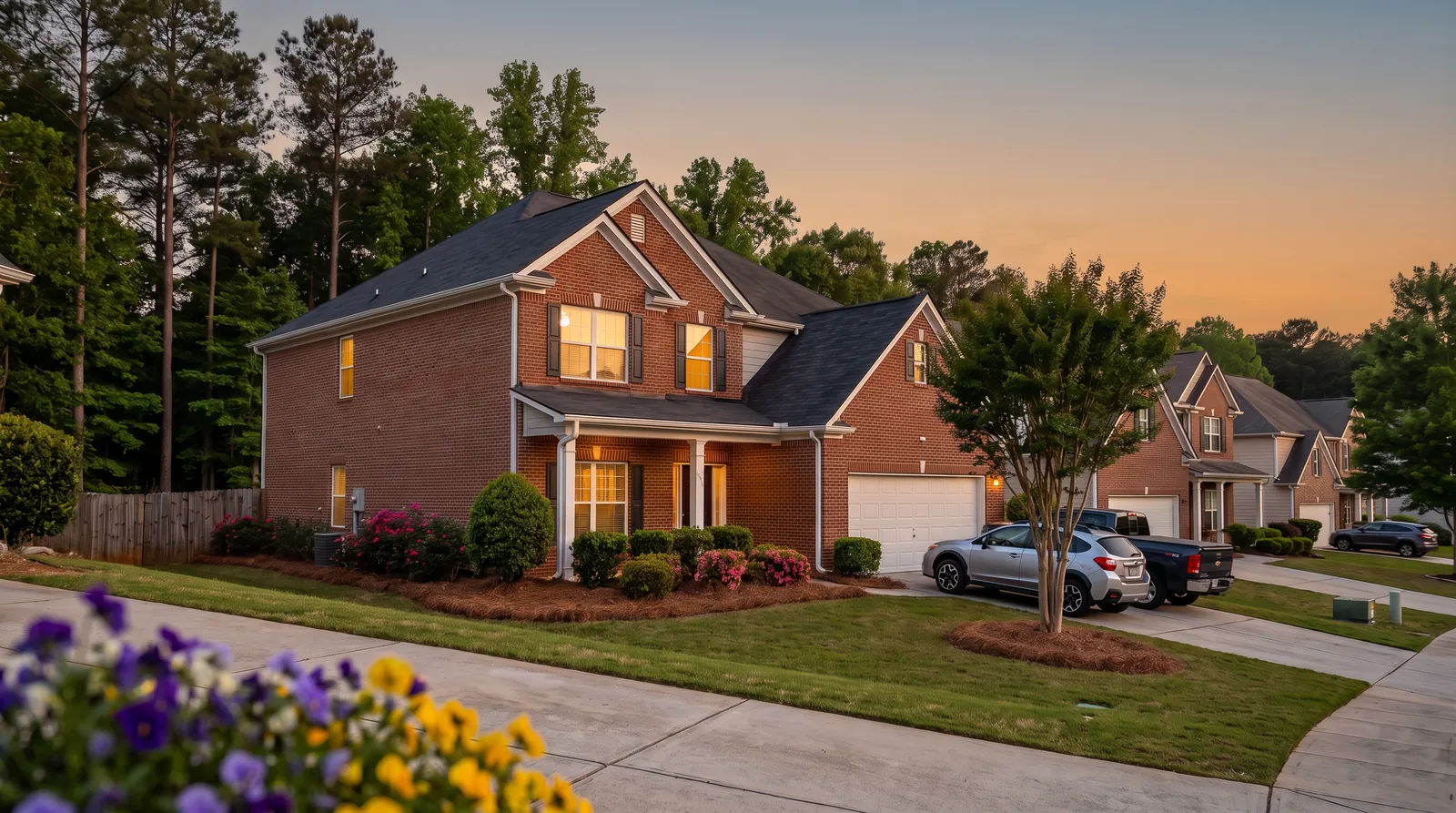
What do Morrow homeowners get wrong about home insurance?
The usual line: "My house is insured for what it's worth, and my deductible is $1,000. If a storm hits, I'm covered."
What's actually true: both numbers may be off. What your house would sell for and what it would cost to rebuild are two different figures, and the policy should be built on the second one. And the $1,000 on your declarations page may not be the deductible that applies after a storm. Some Georgia policies carry a separate deductible for wind, hail or hurricane damage, and when it's figured as a percentage of your dwelling limit, it can be several times larger than the one you remember.
What to do instead: pull your declarations page and find three things: the dwelling limit, every deductible listed, and whether water backup appears anywhere. If you can't find one of them, that's the conversation to have before storm season, not after.
If you own a home in Morrow, you've probably watched a spring storm line roll in over the pines and wondered what your policy would actually do if a limb came through the roof. Most of the home insurance questions our office on Southlake Parkway hears aren't about price. They're about what's covered, what isn't, and which deductible applies. This guide answers them for Morrow and the rest of Clayton County in plain English.
- Tornado season
- Mar–MayGeorgia OCI
- Hurricane season
- Jun–NovInland wind and rain reach metro Atlanta
- Helene in Atlanta
- 11.2 inOf rain, September 2024 (OCI)
- Flood policy wait
- 30 daysMost NFIP policies (FEMA)
Should you insure your Morrow home for market value or rebuild cost?
Short answerRebuild cost. Your dwelling limit should match what it would cost to rebuild the house today with similar materials. Market value includes the land and the neighborhood, which a fire or tornado doesn't take.
When people talk about what a house in Morrow is worth, they mean the sale price: the lot, the neighborhood, the short drive to I-75 at Exit 233. None of that burns down. Dwelling coverage, often called Coverage A, pays to repair or rebuild the structure, so the number that matters is what a contractor would charge to put the house back: framing, roof, brick or siding, wiring, plumbing, finishes and labor.
The two numbers can drift apart in either direction, and a dwelling limit set years ago and nudged up a little at each renewal can quietly fall behind what materials and labor cost now. You find out it's short at the worst possible time.
How we check the number
- Start with the house, not the listing. Square footage, stories, foundation, roof type, finishes and recent updates drive rebuild cost.
- Look at how the policy settles. Replacement cost pays to rebuild without subtracting for age, up to your limits; actual cash value subtracts depreciation. Some policies settle the roof differently, so ask how yours works.
- Size the rest from there. Other structures, personal property and loss of use are often set as a share of the dwelling limit, so an outdated Coverage A shortchanges them too.
What does a standard home policy cover in Morrow, and what does it leave out?
Short answerA standard homeowners policy covers the house, other structures, your belongings, extra living costs after a covered loss, liability and guest medical bills. It doesn't cover flood, and water backup usually has to be added.
A homeowners policy bundles several coverages together. Here's what each one does, and the gaps that catch Clayton County homeowners off guard.
The house itself
Walls, roof, foundation and built-ins. Set this limit to rebuild cost.
Personal property
What you'd pack in a move. Jewelry and collectibles often have lower sub-limits unless listed separately.
Extra living costs
Pays for a rental or hotel and added costs while a covered loss makes the house unlivable.
Injuries and damage to others
Covers you if a guest is hurt at your home or you damage someone else's property, including legal defense, up to your limit.
Water backup
Water that backs up through a sewer line, floor drain or sump pump is usually excluded unless you add this coverage to the policy.
Rising water
Georgia's insurance regulator says homeowners policies don't cover flood. It takes a separate flood policy, bought ahead of time.
Insurance is built for sudden, accidental damage, so wear and tear, a worn-out roof, slow leaks and rot stay the homeowner's job. On the other side of the ledger, the Georgia Office of Commissioner of Insurance and Safety Fire has said that standard homeowners and renters policies cover damage from burst pipes, the kind of claim a hard freeze can bring.

How do wind and hail deductibles work on a Georgia home policy?
Short answerSome policies apply a separate, often larger deductible to wind, hail or hurricane damage. It may be a flat dollar amount or a percentage of your dwelling limit, and it's the one that applies after most storm claims.
Your declarations page may list more than one deductible. The "all other perils" deductible applies to things like a kitchen fire or a burst pipe. A wind and hail deductible, or a hurricane deductible, applies when the damage comes from a storm. The Georgia Office of Commissioner of Insurance and Safety Fire warned homeowners in its June 2025 hurricane-season guidance that some policies have separate deductibles for hurricanes or wind losses and urged them to understand which one applies before a storm hits.
When that deductible is a percentage, it's figured from your dwelling limit, not from the size of the claim. That's the part that surprises people.
Illustrative example, not a real claim or quote
A spring hailstorm crosses Clayton County and damages the roof and gutters on a Morrow home with a $300,000 dwelling limit. The covered repair estimate is $14,000.
With a flat $1,000 deductible for all perils, the policy pays $13,000.
With a 2% wind and hail deductible, the deductible is 2% of $300,000, or $6,000. The policy pays $8,000, and the homeowner covers the other $6,000. Same storm, same roof, $5,000 difference.
A percentage deductible isn't automatically wrong. It usually lowers the premium, and with a healthy emergency fund it can be a sensible trade. The mistake is having one without knowing it.
- Find it on the declarations page. Look for "wind/hail," "windstorm" or "hurricane" next to a deductible.
- Do the math in dollars. Multiply the percentage by your dwelling limit. That's what you'd need in savings the day after a storm.
- Price the alternatives. Ask what a flat-dollar or lower percentage deductible would add to the premium, if the policy offers one.
When is storm season in Morrow and Clayton County?
Short answerGeorgia's tornado season generally runs from March 1 through the end of May, hurricane season from June 1 to November 30, and winter brings occasional hard freezes. Severe storms can hit outside those windows too.
Morrow sits about 13 miles south of downtown Atlanta, well inland, but that doesn't take it out of the storm track. The Georgia Office of Commissioner of Insurance and Safety Fire says flooding, tornadoes and winter storms cause millions of dollars of property damage in Georgia each year, and its consumer guide puts tornado season at roughly March 1 through the end of May and hurricane season at June 1 through November 30. The National Weather Service's Peachtree City office covers Clayton County; keep weather alerts turned on.
Inland hurricane effects are real here. When Hurricane Helene came through in September 2024, Atlanta recorded 11.2 inches of rain, according to the Georgia Office of Commissioner of Insurance and Safety Fire, which said Helene showed that every part of the state is at risk of severe storm impacts.
Here's how common storm and water losses usually line up against a homeowners policy. Treat it as a map for reading yours, not a promise of coverage.
| The loss | When it tends to happen | What usually responds |
|---|---|---|
| Wind or hail damage to the roof and siding | Spring storm and tornado season, and summer thunderstorms | Covered, check deductible Your homeowners policy, after the wind and hail deductible if you have one |
| A tree falling on the house | Any severe storm | Covered, check deductible Your homeowners policy; tree removal limits vary |
| Burst pipes after a hard freeze | Winter cold snaps | Usually covered Your homeowners policy, per the state insurance regulator; slow leaks are not |
| Water backing up through a floor drain or sewer line | Heavy rain that overwhelms drains | Only if added A water backup add-on to your homeowners policy |
| Rising water from a creek or heavy rain | Tropical systems and slow-moving storms | Not covered A separate flood policy only |
Does home insurance cover water backup in Morrow?
Short answerUsually not unless you add it. Water that backs up through a sewer line, floor drain or sump pump is a common exclusion, and flood insurance doesn't cover it either. A water backup add-on closes that gap.
Water backup is the claim people most often confuse with flood. Flood is water that rises outside and comes in. Backup comes up from inside, through the plumbing, when heavy rain overwhelms the drains or a sewer line clogs. A standard homeowners policy generally excludes it unless you've added the coverage.
The add-on usually has its own limit, often well below your dwelling limit, so check the number as well as the line. If you have a finished lower level, a floor drain or a sump pump, it's one of the most important lines on the quote.
Do you need flood insurance in Morrow?
Short answerIt depends on where your home sits, but no homeowners policy covers flood, and most flood policies take 30 days to start. Check your address on FEMA's flood map and decide before storm season, not during it.
The Georgia Office of Commissioner of Insurance and Safety Fire says it plainly: homeowners policies do not cover flood. Rising water from a creek, a river or heavy rain needs a separate policy, either through the National Flood Insurance Program or a private flood insurer. Under the NFIP, a single-family home can be insured for up to $250,000 on the building and $100,000 on contents, and most policies take effect 30 days after purchase. A policy bought as part of a mortgage transaction is the exception, with no wait, according to FEMA.
Morrow's flood picture is local, and it follows the water. The Flint River begins in urban streams piped beneath Hartsfield-Jackson Airport, just minutes from Morrow. The U.S. Geological Survey monitors Jester Creek in and near Morrow, along with Flint River sites near Jonesboro, Riverdale and Forest Park. FEMA flood studies for Clayton County have named Beaver Dam, Hurricane, Jester, Mud, Panther, Sullivan and Upton Creeks. Two streets in the same subdivision can fall in different flood zones, so the only reliable answer is your address on the FEMA Flood Map Service Center.
A home outside a high-risk zone can still flood, especially when a tropical system stalls and drops days of rain. FEMA's National Flood Insurance Program says that just 1 inch of floodwater can cause roughly $25,000 of damage to a home. If your lender doesn't require flood coverage, the decision comes down to how close you are to a creek or low ground and whether you could absorb that loss.
What affects the cost of home insurance in Morrow, and does bundling help?
Short answerYour rebuild cost, roof, age and condition of the home, claims history, deductibles and the coverage you choose drive the price. Bundling home and auto with one agency may lower your total cost, without giving up coverage.
We don't publish a typical Morrow premium, because there isn't a reliable public figure for Morrow or Clayton County, and two homes on the same street can price very differently. What we can tell you is what moves the number:
- The dwelling limit. More rebuild cost means more premium. That's the right trade; under-insuring is the expensive way to save.
- The roof. Age, material and condition matter a great deal in Georgia hail and wind.
- Age and updates. Updated electrical, plumbing and heating can make an older home easier to insure.
- Your deductibles. Higher deductibles lower the premium. Only choose one you could pay from savings the day after a storm.
- Claims history and protective features. Prior claims can affect price; monitored alarms and similar features may qualify for discounts on some policies.
Bundling home and auto
Putting home and auto with the same agency is one of the most common ways households lower their total insurance cost, and bundling discounts may be available depending on the policy. It also puts both on one renewal conversation, so liability limits line up. Check the auto side while you're at it: Georgia's 25/50/25 liability minimum is far below what most homeowners have to protect. Our Georgia car insurance guide explains how to size it.
And if a home has trouble getting coverage in the regular market, Georgia has a backstop. The Georgia Underwriting Association, the state's FAIR Plan created under O.C.G.A. Title 33, Chapter 33, exists so property owners who can't find coverage in the regular market can still get basic property insurance. Its coverage can be narrower than a standard homeowners policy, so it's a last resort, not a starting point.
What does a Morrow home insurance quote conversation look like?
Short answerAbout 15 minutes with a licensed agent: we confirm the house details, recalculate rebuild cost, walk through each deductible and gap, then line up the new policy so it starts the day the old one ends.
Here's what to have ready, by phone or at our office at 1395 Southlake Parkway, near Southlake Mall, in English or Spanish.
- Your current declarations page. It shows your dwelling limit, every deductible and your add-ons, so we can compare line for line. If you'd rather not dig for it, you can share your current policy securely through our free policy review.
- The house basics. Address, year built, square footage, number of stories, foundation type and roof age and material.
- Updates. The years the roof, electrical, plumbing and heating and cooling were replaced, if you know them.
- Your mortgage details. Lender name, loan number and whether the premium is paid through escrow.
- Claims history. Any home insurance claims in recent years.
If your premium is paid through escrow, switching takes a little coordination. The new policy should start the day the old one ends, list your lender, and reach the lender with its declarations page so escrow pays the right insurer. Cancel the old policy only after the new one is in force. We handle that paperwork with your lender.
The Bottom Line
If you do one thing after reading this, find your declarations page and check three numbers: your dwelling limit, every deductible listed, and whether water backup appears at all. If the dwelling limit was set years ago, it may be short of today's rebuild cost. If there's a percentage wind and hail deductible, multiply it out so you know the dollar amount before a storm does it for you.
Then remember how the pieces fit in Morrow. Spring brings tornado season, and summer and fall bring tropical wind and rain. A homeowners policy covers storm damage to the house after the right deductible, and burst pipes are generally covered. Water backup is usually an add-on. Flood is always a separate policy, with a 30-day wait for most.
The homeowners who come through a bad storm well are the ones who knew what their policy said before they needed it. For how we put Georgia home policies together, see our home insurance page, or start a quote below.
Related Questions Morrow Homeowners Ask
Is home insurance required in Georgia?
Georgia doesn't require homeowners insurance the way it requires liability coverage on a car. But if you have a mortgage, your lender will require it, because the house is the collateral for the loan, and the lender will usually need to be listed on the policy. Even with the house paid off, most owners keep a policy, because it pays to rebuild after a fire or storm and covers liability if someone is hurt on the property.
Does homeowners insurance cover flooding in Georgia?
No. The Georgia Office of Commissioner of Insurance and Safety Fire says homeowners policies do not cover flood. Rising water from a creek, a river or heavy rain needs a separate flood policy through the National Flood Insurance Program or a private flood insurer. Most NFIP policies take effect 30 days after purchase, according to FEMA, unless the policy is bought as part of a mortgage transaction, so buy before storm season. Water that backs up through a drain is a different coverage, usually added to the homeowners policy.
What is a wind and hail deductible?
It's a separate deductible that applies only to damage from wind, hail or, on some policies, hurricanes. It may be a flat dollar amount or a percentage of your dwelling limit. With a 2% deductible on a home insured for $300,000, you'd pay the first $6,000 of a covered storm claim. The Georgia insurance regulator advises checking which deductible applies before a storm, so look for it on your declarations page.
Does home insurance cover burst pipes in Georgia?
Usually, yes. The Georgia Office of Commissioner of Insurance and Safety Fire has said standard homeowners and renters policies cover damage from burst pipes, the kind of claim a hard freeze can cause. A slow leak that went on for weeks, or damage from neglect such as leaving a vacant house unheated, is generally not covered.
What if no insurer will cover my home in Georgia?
Ask a licensed agent why the home was declined and whether a repair, such as a new roof, would change the answer. If the regular market still says no, Georgia's FAIR Plan, the Georgia Underwriting Association, exists so property owners can still get basic property insurance. Its coverage can be narrower than a standard homeowners policy, so it's a last resort rather than a starting point.
Last reviewed by Mithferson Joseph, licensed Georgia insurance agent (GA Lic. #3534358, NPN 17942191), on . Sources checked: Georgia Office of Commissioner of Insurance and Safety Fire consumer materials (storm seasons, flood exclusion, burst pipes, its June 2025 hurricane guidance); GEMA/HS's 2022 Hazard Identification and Risk Assessment; FEMA and the National Flood Insurance Program; the U.S. Geological Survey; and O.C.G.A. Title 33, Chapter 33. Written by the All Access Agency team in Morrow, GA, serving Clayton County, Henry County and homeowners across Georgia. General information, not a substitute for reading your own policy. Coverage depends on your specific contract, and not every coverage or discount is available on every policy. For consumer help, see the Georgia Office of Commissioner of Insurance and Safety Fire.